
May 31, 2026
Re: "On Church and State in the Information Age: A Few Nagging Questions"

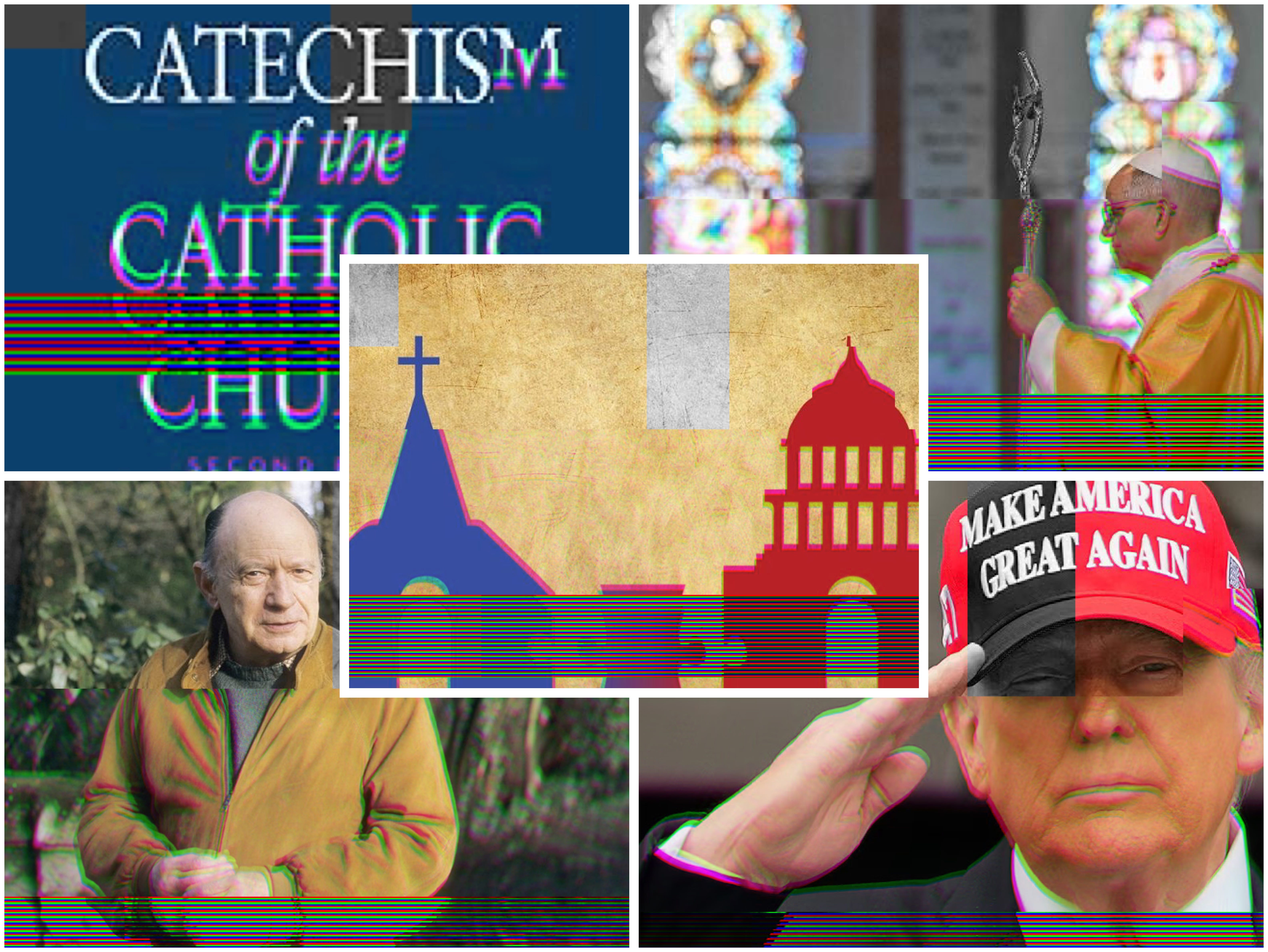
Let me be clear upfront: this is not a post on the so-called “rift” between President Donald J. Trump and Pope Leo XIV. After all, Amy Welborn and I discussed what I playfully dubbed “The Thrilla at the Basilica” on Just FYI Pod: Culture a few weeks ago (linked below), and, in any case, a plethora of ink has

been spilled on this subject from all corners of the political spectrum. Enough is enough.
What I do want to do, however, is explore the philosophical and theological tension underlying this debate. Yet, even here, I need to be careful. Discussions about “the separation of Church and state” are often conceptually imprecise and historically negligent. There is a good reason for that: the conditions that brought about this division are incredibly complex, so much so that they simply can’t be addressed in a New York Times column or a Substack essay, much less a Twitter thread! Thus my goals here are more modest. First, I want to narrow my focus to a key question: what does the Catechism of the Catholic Church (CCC) teach about the separation of Church and state? Second, after having addressed this matter, I want to put a few questions to the CCC—not in treacherous opposition but in a spirit of humble inquiry.
Before beginning, I should note why I have chosen to exegete the CCC. First, it is significant that not one but two popes spearheaded its development. The first was Pope Saint John Paul II (1920-2005), who, in November 1985, convened a synod to assess the Church’s implementation of the goals of the Second Vatican Council. It was at this time that the idea of a proper catechism was introduced. As John Paul II later put it:
On that occasion the Synod Fathers stated: "Very many have expressed the desire that a catechism or compendium of all Catholic doctrine regarding both faith and morals be composed, that it might be, as it were, a point of reference for the catechisms or compendiums that are prepared in various regions. The presentation of doctrine must be biblical and liturgical. It must be sound doctrine suited to the present life of Christians. After the Synod ended, I made this desire my own, considering it as "fully responding to a real need both of the universal Church and of the particular Churches". For this reason we thank the Lord wholeheartedly on this day when we can offer the entire Church this reference text entitled the Catechism of the Catholic Church, for a catechesis renewed at the living sources of the faith!
The second pope involved in the CCC was, of course, not a pope at that time. His name was Joseph Ratzinger—former Archbishop of Munich and Freising (1977-82) and Prefect of the Sacred Congregation for the Doctrine of the Faith from 1981 until his election as Pope Benedict XVI in 2005. It was Ratzinger who chaired a commission of 12 cardinals and bishops who prepared the foundational draft of the CCC. Yet, as he remarked in 2011, the preparation of the CCC was more than a human, bureaucratic endeavor: “I must confess that even today [2011] it seems a miracle to me that this project was ultimately successful.”
There is, then, legitimate ecclesial and theological heft undergirding the CCC. This was hardly a document put together without sincerity or thoughtfulness. But there is a second, even more important reason to give priority to the CCC: it has been deemed standard for Catholic teaching and life. In his apostolic constitution Fidei Depositum, published in October 1992, John Paul II states:
The Catechism of the Catholic Church…is a statement of the Church's faith and of Catholic doctrine, attested to or illumined by Sacred Scripture, Apostolic Tradition and the Church's Magisterium. I declare it to be a valid and legitimate instrument for ecclesial communion and a sure norm for teaching the faith. May it serve the renewal to which the Holy Spirit ceaselessly calls the Church of God, the Body of Christ, on her pilgrimage to the undiminished light of the kingdom!
The word “catechism” stems from the Greek verb κατηχέω, which in a biblical context means “to instruct,” “to teach,” or “to inform.” Thus a catechism is indeed an extension of the “magisterium” of the Church—a word that itself is related to Latin noun magister (“teacher”). Given this status, it’s hardly surprising that, as of May 2024, the CCC had been published in 44 languages and sold nearly 20 million copies worldwide.
It’s fair to say, then, that the CCC is a substantial work in terms of its composition, authority, and reach. Whatever it says about the relationship between Church and state should be taken seriously. The first significant discussion of the state is found in Chapter Two of Section One of the CCC’s third overarching division called “Life in Christ.” The title of this chapter is “The Human Community,” and it is subdivided into three articles.
The first article lays out a number of broad principles about human sociality. Since all human beings have God as their origin and end, and since Scripture inextricably links both love of God and love of neighbor (Matthew 22:36-40), the CCC presupposes a “fraternity that men are to establish among themselves in truth and love” (§ 1878). The individual, then, is never a fully autonomous unit; each person “needs to live in society” (§ 1879). Of course, any number of societies are implied here, from fantasy baseball leagues to the local Kiwanis club. Yet, the CCC insists that two forms of society are essential: “Certain societies, such as the family and the state, correspond more directly to the nature of man; they are necessary to him” (§ 1882). But there is a careful dialectic at play here: while individuals are supposed to respect and serve the communities to which they belong, communities are only considered valid insofar as they promote the good of individuals. Drawing on the pastoral constitution Gaudium et spes (1965), the CCC states: “Each community is defined by its purpose and consequently obeys specific rules; but ‘the human person... is and ought to be the principle, the subject and the end of all social institutions.’” (§ 1881). Indeed, when this principle is lacking, “socialization also presents dangers” (§ 1883).
Although the CCC recommends “subsidiarity” to cope with dangers such as “excessive intervention by the state” (§ 1883), it does not deny the role that authority plays in human social life: “Every human community needs an authority to govern it. The foundation of such authority lies in human nature. It is necessary for the unity of the state. Its role is to ensure as far as possible the common good of the society” (§ 1898). So political leaders are essential, and obedience to such leaders is nothing short of a “duty” (§ 1900). These points are firmly asserted, though the CCC refrains from specifying how political leaders are to be selected:
If authority belongs to the order established by God, “the choice of the political regime and the appointment of rulers are left to the free decision of the citizens.” The diversity of political regimes is morally acceptable, provided they serve the legitimate good of the communities that adopt them. Regimes whose nature is contrary to the natural law, to the public order, and to the fundamental rights of persons cannot achieve the common good of the nations on which they have been imposed. (§ 1901)
Catholics, then, are not required to support federal republics along the lines of the United States. Yes, a legislative system of “checks and balances” is preferred (§ 1904), but the non-negotiable point is that political power, however structured, is meant to serve the common good: “Authority is exercised legitimately only when it seeks the common good of the group concerned and if it employs morally licit means to attain it. If rulers were to enact unjust laws or take measures contrary to the moral order, such arrangements would not be binding in conscience” (§ 1903).
The CCC provides a threefold definition of the “common good.” First, this notion assumes a “respect for the person as such,” whereby each individual is free to exercise “the natural freedoms indispensable for the development of the human vocation” (§ 1907). Second, the common good entails access to that which “is needed to lead a truly human life: food, clothing, health, work, education and culture, suitable information, the right to establish a family, and so on” (§ 1908). Third, and finally, the common good requires “the stability and security of a just order” (§ 1909). Now, each form of human association presupposes a common good—to be sure, my fantasy baseball league would collapse if a few members were prevented from making waiver claims, or if a cadre of league members colluded against the others—but the CCC is clear that the state is the ultimate guarantor of the common good:
Each human community possesses a common good which permits it to be recognized as such; it is in the political community that its most complete realization is found. It is the role of the state to defend and promote the common good of civil society, its citizens, and intermediate bodies (§ 1910).
In this situation, the role of the citizen is to participate in the advancement of the common good. This form of engagement entails taking an “active part in public life,” though the CCC is careful not to prescribe the manner or the amount of one’s public participation (§ 1915). On the other hand, the CCC is clear that the normative way to support the common good is to live a good and meaningful individual life, with an eye to care for those in one’s immediate environment: “Participation is achieved first of all by taking charge of the areas for which one assumes personal responsibility: by the care taken for the education of his family, by conscientious work, and so forth, man participates in the good of others and of society” (§ 1914). This point even extends to matters of “social justice,” which is inseparable from the notion of the common good and thereby “proceeds by way of respect for the principle that ‘everyone should look upon his neighbor (without any exception) as another self, above all bearing in mind his life and the means necessary for living it with dignity’” (§ 1931).
So where, then, does the state itself come into play? The CCC pivots back to this question in “Life in Christ,” this time in the second chapter of Section Two. The title of this chapter is “You Shall Love Your Neighbor as Yourself,” and it is subdivided into seven articles. The main discussion of the state occurs in Article IV, “The Family and the Kingdom.” While acknowledging that each Christian should be “convinced that the first vocation of the Christian is to follow Jesus” (§ 2232), the CCC also “enjoins us to honor all who for our good have received authority in society from God” (§ 2234). A significant portion of what follows reiterates the material from “The Human Community.” Yes, politicians “are obliged to respect the fundamental rights of the human person” (§ 2237), and, yes, citizens are to “regard those in authority as representatives of God, who has made them stewards of his gifts” (§ 2238). This is the CCC’s core dialectic of Church and state, articulating a relationship of mutual respect that (i) preserves law and order while (ii) simultaneously promoting the common good for each and every individual.
Still, Article IV also makes a number of new and more practical points. For example, citing the need for citizens to advance the common good, the CCC argues that it is “morally obligatory to pay taxes, to exercise the right to vote, and to defend one’s country” (§ 2240). Such duties, it is said, follow the plain teaching of Scripture (Rom 13:7, 1 Tim 2:2). The CCC also touches on the perennially controversial subject of immigration, though, notably, it does not deviate from the dialectic outlined above. On the one side, the “more prosperous nations are obliged, to the extent they are able, to welcome the foreigner in search of the security and the means of livelihood which he cannot find in his country of origin” (§ 2241). And yet, this obligation is not absolute, since “[p]olitical authorities, for the sake of the common good for which they are responsible, may make the exercise of the right to immigrate subject to various juridical conditions” (§ 2241). In a nutshell, citizens should be open to immigration, even as they should also recognize that it’s not an inalienable right. Discretion is not only permitted; it is presupposed.
This is, of course, thorny ground in the contemporary West. In 2026 alone, dozens and dozens of protests over immigration have taken place in the United States, and in some cases people have lost their lives. And yet, the CCC is clear that governments have the right to limit immigration, insofar as they are sincerely acting in accordance with the common good. Any such protests, then, need to rest on grave and well-substantiated grounds. So, what conditions must be present for a person or group to protest, or even to disobey, those who currently hold political power?
Here the CCC draws a distinction between refusing to comply with unjust laws and violently opposing an unjust regime. The former seems more straightforward than the latter. Christianity has long held that “serving God” takes precedence over “serving the political community” (§ 2242; cf. Acts 5:29). Thus the CCC reasons that when a government makes demands that “are contrary to those of an upright conscience,” individuals have warrant to disobey civil authorities (§ 2242). I take this to mean that, if a person in good conscience thought another was being wrongfully persecuted by the legal and political establishment, she would not violate Catholic teaching by refusing to disclose, say, the location of the oppressed person. Her love of God and neighbor eo ipso takes precedence over regnant sociopolitical conceptions and applications of justice.
By way of contrast, forceful resistance to the government is only permissible when a number of specific conditions are concurrent:
Armed resistance to oppression by political authority is not legitimate, unless all the following conditions are met: 1) there is certain, grave, and prolonged violation of fundamental rights; 2) all other means of redress have been exhausted; 3) such resistance will not provoke worse disorders; 4) there is well–founded hope of success; and 5) it is impossible reasonably to foresee any better solution (§ 2243).
In effect, the CCC sets the bar very high for violent protests, to say nothing of full-blown revolutions. If a governmental agency were said to be abusing the rights of a certain group of people, that still does not justify brutality against the authorities in question. Before attacking municipal or federal agents and their property, dissidents are asked to exhaust all other “means of redress,” including the political process itself and the possibility that future solutions may emerge. Hence, in the vast majority of cases, the CCC insists that violent rebellion is not morally justified.
That this counsel would be ill-received by rioters, looters, and would-be rebels on both Right and Left is likely. Even the CCC seems to anticipate objections, since it goes on to insist that the Church’s vision of the political community is influenced by “inspired truth about God and man” (§ 2244), a truth that’s not derived from human principles alone:
Every institution is inspired, at least implicitly, by a vision of man and his destiny, from which it derives the point of reference for its judgment, its hierarchy of values, its line of conduct. Most societies have formed their institutions in the recognition of a certain preeminence of man over things. Only the divinely revealed religion has clearly recognized man’s origin and destiny in God, the Creator and Redeemer (§ 2244).
Yet, groups or societies who reject the Church’s teaching are warned that they do so at their own peril. Citing John Paul II’s 1991 encyclical Centesimus annus, the CCC points out that, in the absence of a transcendent criterion, political institutions “arrogate to themselves an explicit or implicit totalitarian power over man and his destiny, as history shows” (§ 2244). Thus tragedy ensues. For that reason, it is crucial that the Church continue “to pass moral judgments” (§ 2246) in matters of state, even though the Church itself “is not to be confused in any way with the political community” (§ 2245). Ecclesial judgment is “in accord with the Gospel and the welfare of all men” and thereby serves “the transcendent character of the human person” (§ 2245-46), rather than any coercive power.
This is a conceptually dense, if not utterly exhaustive, synopsis of the CCC’s teaching on the relationship between Church and state. Taken as a whole, I think the CCC tenders a worthwhile and, at times, edifying account of how Christians are to engage the secular political order. Still, as noted at the outset, I have questions. I do not pose them as a provocation; I pose them as a mode of reflection. For, as a Catholic (however unworthy), I want to be able to apply the CCC’s teaching on Church and state to my own life and thinking. At times, however, it’s not clear to me how to do so. Framing these questions, then, is a way of elucidating what I think I understand about the CCC’s position—and what I’m pretty sure I don’t.
When the CCC declares that the state is “necessary” (§ 1882) to human life, is this conclusion sufficiently nuanced? After all, many tribal peoples (e.g., the Mbuti in the Congo Basin, the Yanomami of the Amazon rainforest) have long subsisted without the political organization known as “the state.” Elsewhere the CCC allows for a “diversity of political regimes” (§ 1901), but this allowance seems to be within the statist paradigm (from federations to theocracies). It never accounts for the historically contingent birth of the state as such.
The CCC warns against the state’s “excessive intervention” (§ 1883) in the lives of individuals, but what, exactly, does this mean? Presumably it includes governmental intervention in religious matters—say, forcing Catholic hospitals to provide abortions—but would it also include softer but no less manipulative forms of intervention? Is it “excessive” if a political party actively engages in disinformation campaigns online (astroturfing, sockpuppeting, etc.), even though no one is physically harmed? What if all politicians and/or political groups do so to one degree or another? Is it possible to distinguish between “excessive intervention” and “sensible intervention”?
If the state is meant to provide the “just order” (§ 1909) by which each individual is able to exercise her “natural freedoms” (§ 1907) and thereby “lead a truly human life” (§ 1908), at what point does the state abrogate its moral and political authority by failing to secure such an order? I recently finished reading Erik Larson’s 2011 book In the Garden of Beasts: Love, Terror, and an American Family in Hitler's Berlin, which sees the rise of Nazism through the eyes of the American historian and diplomat William Dodd. One of the most compelling aspects of Larson’s text is how real-time observers, both in Germany and abroad, had a hard time deciding if the Nazis were a genuine threat to the global order—or just an overzealous party of bullies and fools. Early attacks against Jews (and non-Jewish Americans, for that matter) were dismissed as “anomalous” or “unfortunate;” it was not at all self-evident that the Nazis were preparing the ground for an epoch of murder and tyranny. Of course, people today would like to think that it won’t happen again, and doubtless there is plenty of Nazi fearmongering in the news and on social media. But what if the state has gotten smarter? What if the limitation of our “natural freedoms” is now accomplished in more subtle ways? “Ah,” one might say, “but nothing is as bad as the Shoah.” That is likely true; it is also the point at issue. In an age of mass propaganda, fueled by the interests of both states and corporations, are we supposed to just shrug off the infinitesimal injustices that happen online? And, if we do shrug them off (as most of us do), what then? Are we, in effect, dispensing with the very ideal of a “just order”?
The CCC insists that citizens have a moral obligation to vote (§ 2240), but it would seem that this responsibility is bound up with the presupposition that the state is necessary to human flourishing (§ 1882). Yet, if the latter is questionable, is the Catholic obligation to vote still binding? Famously, the American activist and Benedictine oblate Dorothy Day (1897-1980) refused to exercise her right to vote. It would seem, then, that the CCC puts too great an emphasis on this duty. Moreover, there is an even bigger problem lurking beneath the surface. Given the number of state-driven tragedies over the last, say, 250 years, should the matter be inverted? That is to say, should Catholics assume that, until better governments and better leaders emerge, voting is the riskier and arguably less moral option?
If, according to the CCC, the Church is not to be confused with “the political community” (§ 2245), a point that Pope Leo XIV has recently echoed as well, then how can the Church tender its “moral judgments” (§ 2246) of state politics without getting tangled up in partisan conflicts itself? Whether it’s bishops aligning themselves with particular politicians, or Catholic universities encouraging active involvement in political parties and governmental affairs, it appears that the fine line between promoting “the message of the Gospel” (as the Holy Father put it) and state involvement is often blurred. But is this blurring a “feature” or a “bug” of the CCC’s treatment of Church and state?
I could multiply such questions, but, again, the fundamental concern of this post is to sum up the CCC’s position on matters of Church and state and to register a few (rather than an abundance) of questions stemming therefrom. Of course, how one might respond to these queries is a different matter altogether. Myself, I am at least sympathetic to the perspectives of thinkers like Søren Kierkegaard (1813-55) and Jacques Ellul (1912-94), who argue that, in an age of mass media, even the Church’s moral critique of political policy is simply absorbed and flattened into the equilibrium of the modern liberal state. That doesn’t mean that such critiques are ipso facto empty and foolish. It does mean that they are more performative than effectual and that a subtler approach than the one found in the CCC may be needed.
As for that subject, however, a fuller discussion will have to wait until the upcoming release of my new book Kierkegaard, Statecraft, and Political Theology, which concludes by pondering (not prescribing) a number of “principles” for Christian political involvement.