
June 11, 2026
Re: "New Book!!! Introducing KIERKEGAARD, STATECRAFT, AND POLITICAL THEOLOGY"

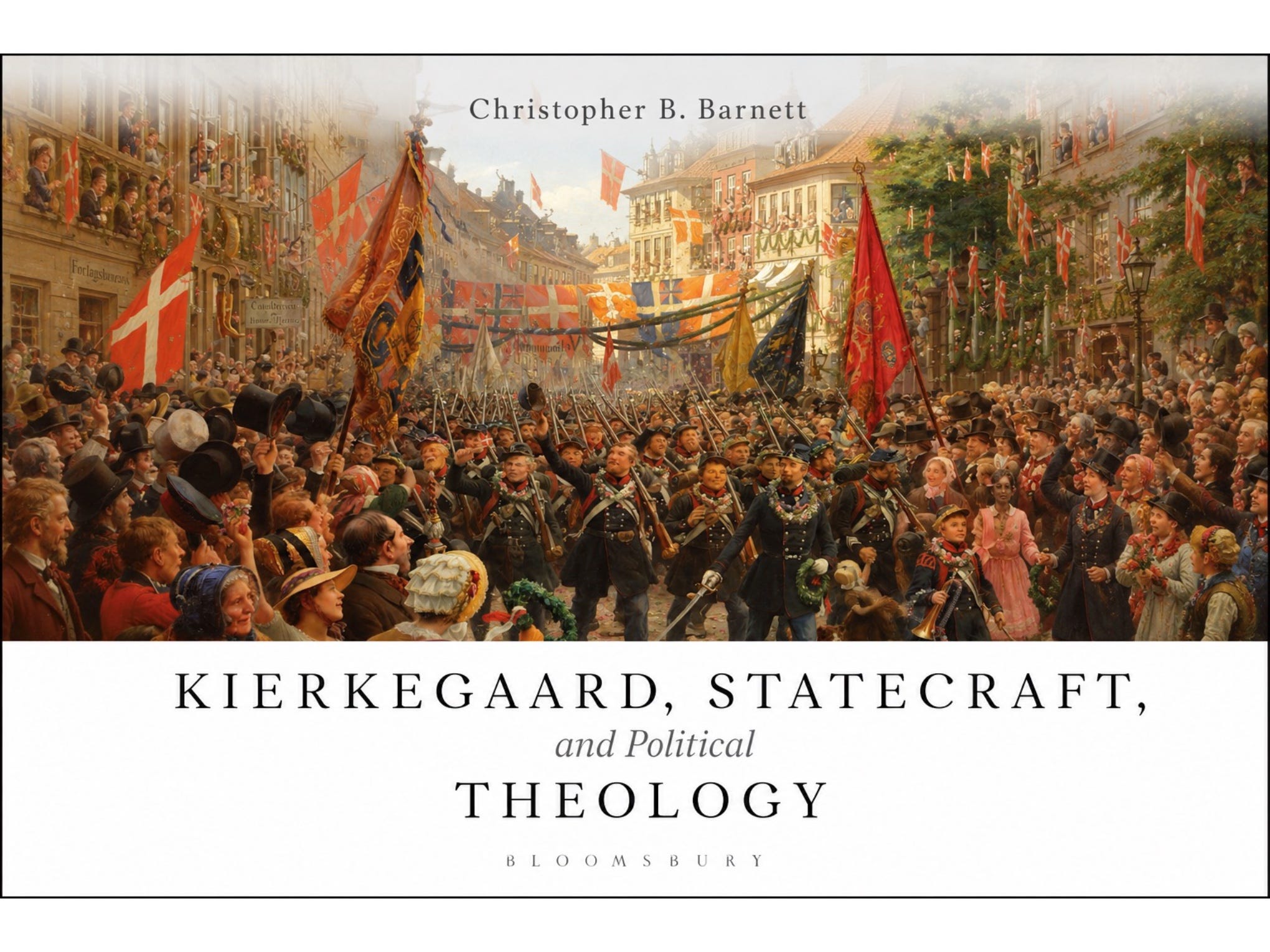
I’m happy to announce that my latest book—Kierkegaard, Statecraft, and Political Theology—has now been published. Here’s the official synopsis from Bloomsbury’s website:
Written against the fractured landscape of contemporary Christianity and the increasing popularity of “political theology,” Christopher B. Barnett wrestles with the question: what if Søren Kierkegaard's rejection of modern politics was not a form of spiritual quietism, but of Christian resistance?
Tracing the rise of the modern secular state, Barnett argues that Kierkegaard's refusal of “the political” anticipates a crisis now impossible to ignore. For Kierkegaard, obsessive political passion signals a theological inversion: as the state grows in importance, God is displaced. The upshot is not freedom but moral exhaustion—a society saturated with envy, despair, and groupthink.
Barnett contends that Kierkegaard's reflections on politics and the modern state find a receptive audience in a trio of twentieth-century figures: Dietrich Bonhoeffer, Jacques Ellul, and René Girard. Loosely gathered under the heading of “apostolical radicalism,” each of these thinkers demonstrates that the modern state organizes contemporary life through bureaucracy, technique, propaganda, and ritualized antagonism. State politics may promise meaning, identity, and moral clarity, but as the rise of political theology shows, it ultimately absorbs all aspects of life into the sphere of politics.
Kierkegaard, Statecraft, and Political Theology unleashes Kierkegaard's political thought as a live provocation, drawing unexpected lines between Christian theology and praxis and our present age of social media, tribalized politics, and permanent war. Ultimately, this book challenges readers to ask whether the modern state leads towards salvation—or the apocalypse.
When, after years of work, I submitted my manuscript to the publisher last fall, I wondered if the world’s political situation would stabilize in the coming months, thereby necessitating a revision (if not a retraction) of my core thesis. But, alas, recent events have only confirmed the argument of Kierkegaard, Statecraft, and Political Theology, making it all the more urgent to heed the voices of Kierkegaard, Bonhoeffer, Ellul, and Girard.
Doubtless disagreements will remain, but, as I see it, the important thing is to keep asking questions. For it is by questioning that we resist the totalizing logic of the state system. In this way, we’re able to relate to one another as individuals and, indeed, as neighbors (Matt 22:37-39).
Below is a Table of Contents. I hope you will find it of interest!
Preface
Chapter 1: The Origin and Development of the Modern State: A Survey
Chapter 2: Kierkegaard at War: Slesvig-Holsten and Christian Resistance to the Modern State
Chapter 3: “Apostolical Radicalism” after Kierkegaard: Bonhoeffer, Ellul, and Girard
Chapter 4: The Politization of the Sacred; or, the Danger of “Political Theology”
Epilogue: “My Kingdom Is Not of This World”: Apostolical Radicalism and the Future
Works Cited
"Barnett contends that Kierkegaard's reflections on politics and the modern state find a receptive audience in a trio of twentieth-century figures: Dietrich Bonhoeffer, Jacques Ellul, and René Girard."
The three most influential writers in my life. (Add F.D. Maurice and it would have just been too uncanny.) I will be reading your book. Always enjoy your essays and podcasts. First ran across you with your wonderful book on Dylan.
I’m looking forward to reading this. The cover is amazing. If one is judging this book by its cover, it’s going to be a great read. Well done, Chris. I’m enjoying your podcast as well.