
July 30, 2026
Re: "WIDOW'S BAY and the Sacrificial Economy: The Choice Between Agamemnon and Abraham"

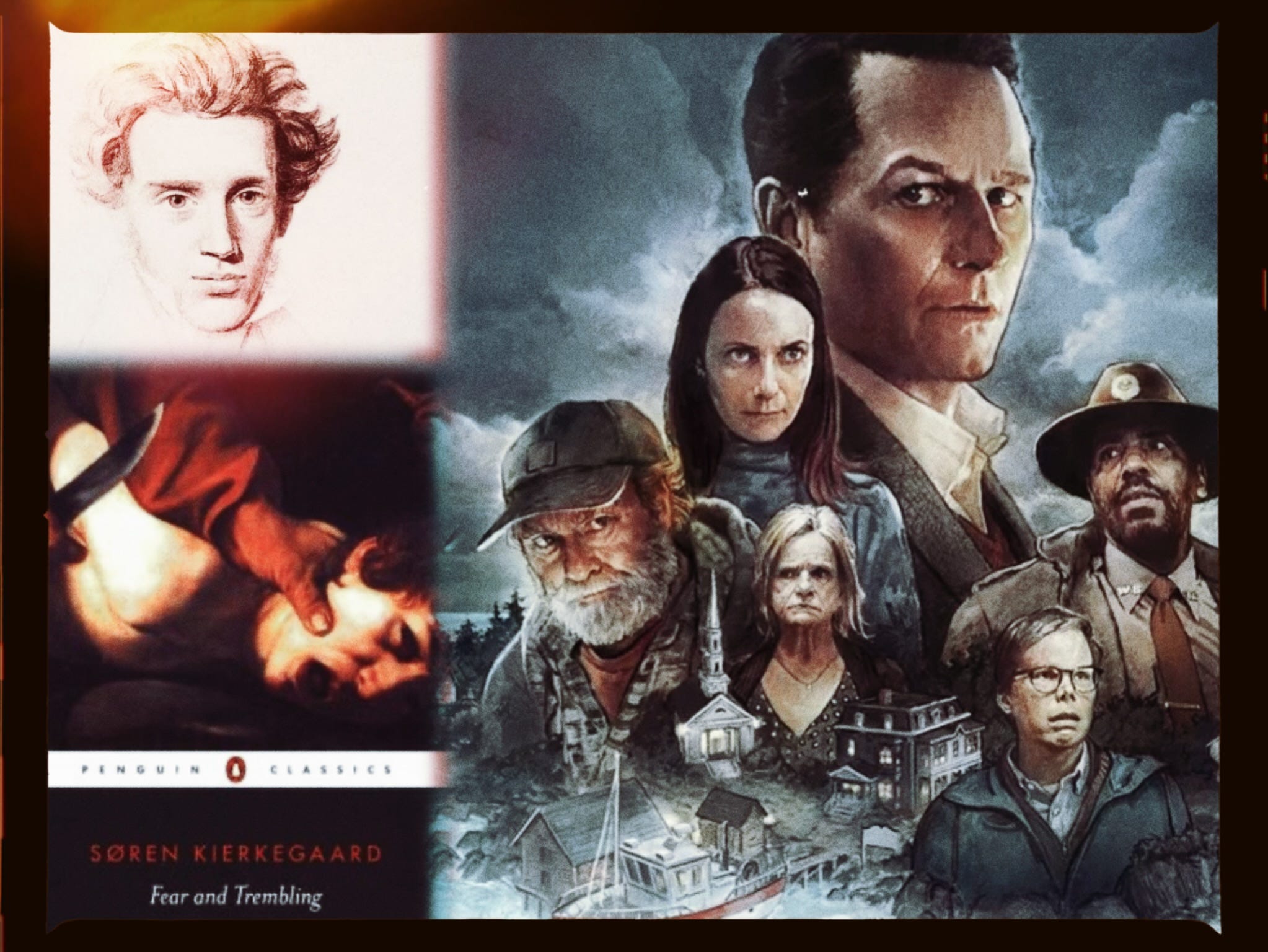
When Apple TV released Widow’s Bay in April, I immediately decided to give it a try. At this point in my life, I think it’s fair to say that I have an affinity for nautical fiction. From novels such as Herman Melville’s Moby-Dick (1851) and Ernest Hemingway’s The Old Man and the Sea (1952) to films such as Steven Spielberg’s Jaws (1975) and Peter Weir’s Master and Commander: The Far Side of the World (2003), adapted from Patrick O’Brian’s excellent Aubrey-Maturin book series (1969-2004), I have always gravitated towards stories about humanity’s relationship with the dread sublimity of the sea. And if you throw in a coastal New England setting, that’s even better. Widow’s Bay, then, had me at hello.
And yet, while the show borrows from the genres of nautical fiction and New England gothic—making Jaws a particularly apt comparison—it combines additional elements of comedy, mystery, and horror to produce a unique and captivating first season of television. The show is set in the fictional town of Widow’s Bay, located on an eponymous New England island whose history is marked by disappearances, hauntings, unexplained deaths, and an ever-present belief that the town is cursed. At the center of the narrative is Mayor Tom Loftis (Matthew Rhys), a kind if also ambitious widower, who hopes to revive the island’s struggling economy by attracting tourism and convincing outsiders that the legends surrounding Widow’s Bay are nothing more than local color. As increasingly supernatural events undermine his efforts, Tom is joined by his eccentric assistant Patricia Moyer (Kate O’Flynn), the island’s folklore expert Wyck Crawford (Stephen Root), the weary Sheriff Bechir Clemmons (Kevin Carroll), and a cast of quirky townspeople who have insight into the island’s hidden past. Meanwhile, Tom’s rebellious teenage son Evan (Kingston Rumi Southwick) becomes entangled in the island’s mysteries, while flashbacks gradually reveal that the curse’s origins date back to the seventeenth century.
Indeed, as the investigation unfolds, Tom discovers that Widow’s Bay is sustained by a centuries-old covenant forged between the community’s founder Richard Warren (Hamish Linklater) and an unidentified malevolent force. In particular, the island’s relative peace has long been dependent on human sacrifice, transforming the town into what might be called a “sacrificial economy” wherein communal survival is purchased through the deaths of selected victims. What begins, then, as Tom’s campaign to modernize Widow’s Bay becomes an existential crisis, as he realizes that his office has always entailed the stewardship of a murderous inheritance. The season therefore culminates in an impossible moral dilemma: Tom learns that ending the curse requires sacrificing someone from Warren’s bloodline, though the identity of that person remains in doubt until the last scene of the season’s tenth and final episode. By the end, Widow’s Bay shifts from a quirky New England mystery into a meditation on inherited guilt, communal violence, and the persistence of sacrificial systems that bind generations together—whether they choose them or not.
Critics have interpreted Widow’s Bay in a variety of ways. For James Poniewozik of The New York Times, the series is a meditation on the tension between ancient superstition and post-Enlightenment reason, between supernatural belief and secular progress:
The conflicts [in Widow’s Bay] are echoed in communities everywhere. Do newcomers owe deference to long-timers, or do the preservationists need to step aside and let the future roll in? How do we deal with the buried secrets of our ancestors?
For that reason, he adds, it’s a show very much about America itself. Just as the nation “wrestles with how to celebrate its own history and which parts to ignore,” so do the denizens of Widow’s Bay live uneasily with the unresolved tragedies of its civic past.
Saloni Gajjar of The A.V. Club gives the show a more intimate reading. As she sees it, Widow’s Bay tells the “story of how Tom and his pals deal with dangers lurking below the surface,” particularly those of a psycho-spiritual variety:
The show digs into how this trio isn’t being haunted only by a potentially centuries-old enigma but also by their own traumas. Tom and Wyck each lost a loved one, while Patricia survived a serial killer’s spree. The series acts as a thoughtful rumination on the difficulty of letting go of the past, even if it insists on chasing you down in weird, scary ways.
On this reading, Tom’s “existential crisis” is not so much tied to his mayoral duties as to his wife’s passing. The force that stalks the island is not some demonic thing; it is the death that stalks us all.
These approaches to Widow’s Bay have merit, but they both elide the show’s defining motif of “sacrificial economies.” The first such economy—or a systemic order in which civic peace is repeatedly won through the killing of selected victims—involves the island itself. Episode 6 traces the historical origins of Widow’s Bay, recounting how the community’s founder Richard Warren made a secret pact with a demonic entity controlling the island. According to this covenant, if the inhabitants of Widow’s Bay were to survive their first winter, human sacrifices would be necessary. Moreover, the sacrifices would have to be renewed over time, if the island’s curses were to be held at bay.
But this crisis begets another. Through a series of events, Tom and Wyck become convinced that the only way to break the curse is to end Warren’s bloodline for good. The contract, in other words, extends beyond Warren to all of his kin, meaning that the curse can only be broken by reenacting the sacrificial logic from which it sprang. Hence, as a terrifying storm bears down on the island, there is also a frantic effort to identify Warren’s remaining descendants. Eventually the search zeroes in on Ruth (K Callan), Tom’s elderly secretary. In no way does Tom want to harm Ruth—she’s gentle and warmhearted—but he’s not sure that he has a choice. After all, Ruth’s life is nearing its end, and her death can save everyone in Widow’s Bay. With this in mind, Tom goes to her house and, with nervous indirection, compares his dilemma to the so-called “trolley problem,” as the scene below shows:
This sort of crisis has a significant history in moral philosophy and psychology. In her 1957 essay “The Problem of Abortion and the Doctrine of Double Effect,” British philosopher Philippa Foot (1920—2010) articulates the issue in this way:
Suppose that a judge or magistrate is faced with rioters demanding that a culprit be found for a certain crime and threatening otherwise to take their own bloody revenge on a particular section of the community. The real culprit being unknown, the judge sees himself as able to prevent the bloodshed only by framing some innocent person and having him executed. Beside this example is placed another in which a pilot whose airplane is about to crash is deciding whether to steer from a more to a less inhabited area. To make the parallel as close as possible, it may rather be supposed that he is the driver of a runaway tram, which he can only steer from one narrow track on to another; five men are working on one track and one man on the other; anyone on the track he enters is bound to be killed.
So, what is one to do? For classical utilitarians such as Jeremy Bentham (1748—1832) and John Stuart Mill (1806—73), this is not a particularly difficult decision: since morality entails securing the greatest good for the greatest number, persons in Tom’s (unfortunate) position have no choice but to sacrifice the Ruths of the world.
Others would disagree. After all, it’s neither Tom’s nor Ruth’s fault that they are in this position. If Widow’s Bay is destroyed, the blame lies with Warren and, ultimately, with the evil entity ruling the island. On the other hand, if Tom elects to murder Ruth, he is now a participant in the system of immorality presiding over Widow’s Bay. On this logic, it would be better for Tom to do nothing and to let fate decide. In his 2017 book On Human Nature, Sir Roger Scruton critiques the “trolley problem” in this way: “These 'dilemmas' have the useful character of eliminating from the situation just about every morally relevant relationship and reducing the problem to one of arithmetic alone.”
Nevertheless, within the sacrificial logic of Widow’s Bay, it may well appear that Tom has no choice: a single life is, relatively speaking, a small price to pay to save everyone else on the island. In fact, Tom’s situation recalls one of the great tales of Greek mythology. In Aeschylus’ Agamemnon (Ἀγαμέμνων), the first of three tragedies that make up the collection known as the Oresteia (Ὀρέστεια), the eponymous king of Mycenae returns home victorious after the Trojan War. But all is not well. Agamemnon’s wife, Clytemnestra, is plotting his murder. Her motivations are manifold—the desire for the throne, her adulterous relationship with Aegisthus, and, above all, her unquenchable rage over Agamemnon’s sacrifice of their daughter, Iphigenia, at the port of Aulis. Before the Greek fleet could sail for Troy, unfavorable winds—sent by the goddess Artemis—left the army stranded. The seer Calchas declared that only the death of Iphigenia would appease the goddess and allow the expedition to proceed. Torn between his duty as a father and his obligation as commander of the Greek coalition, Agamemnon chose the latter, consigning his daughter to death for the sake of the larger cause.
In short, Agamemnon inherits a world governed by a sacrificial logic. He does not invent the system, but he accepts its terms and discovers that the preservation of community can exact a terrible human price. The same, it seems, is true of Tom. In referencing the trolley problem, he suggests that sacrificing one life to save many is morally permissible on utilitarian grounds. In this regard, Tom’s dilemma resembles the logic of the “tragic hero,” as detailed in Søren Kierkegaard’s masterwork Fear and Trembling (Frygt og Bæven, 1843). According to Kierkegaard’s pseudonym, Johannes de silentio, Agamemnon’s sacrifice of Iphigenia is an act that, while heartbreaking, garners pity and even support. Agamemnon takes on personal guilt and grief for the sake of a higher ethical obligation that others can recognize. As Johannes puts it:
When an enterprise of concern to a whole nation is impeded, when such a project is halted by divine displeasure, when the angry deity sends a dead calm that mocks every effort, when the soothsayer carries out his sad task and announces that the deity demands a young girl as sacrifice—then the father must heroically bring this sacrifice. He must nobly conceal his agony, even though he could wish he were “the lowly man who dares to weep” and not the king who must behave in a kingly manner. Although the lonely agony penetrates his breast and there are only three persons in the whole nation who know his agony, soon the whole nation will be initiated into his agony and also into his deed, that for the welfare of all he will sacrifice her, his daughter, this lovely young girl. O bosom! O fair cheeks, flaxen hair (v. 687). And the daughter’s tears will agitate him, and the father will turn away his face, but the hero must raise the knife. And when the news of it reaches the father’s house, the beautiful Greek maidens will blush with enthusiasm, and if the daughter was engaged, her betrothed will not be angry but will be proud to share in the father’s deed, for the girl belonged more tenderly to him than to the father.1
Johannes adds that this sort of scenario crops up time and again in world literature, whether in the Bible (Judges 11) or in the great histories of the past (Livy, History of Rome). What unites these cases is the fact that the tragic figures in question receive “admiration for their deed.” In other words, the act of murder is met with “tears of compassion,” since it is done in the name of a higher good:
The tragic hero is still within the ethical. He allows an expression of the ethical to have its τέλος in a higher expression of the ethical; he scales down the ethical relation between father and son or daughter and father to a feeling that has its dialectic in its relation to the idea of moral conduct.
This is the very dilemma that Widow’s Bay sets up, and it’s made even more dramatic in the season’s final moments, when [‼️spoiler alert‼️] Tom learns that his son Evan is also a descendant of Richard Warren. Suddenly, he finds himself in the very shoes of an Agamemnon, confronting whether or not he has the mettle to sacrifice his only son to satisfy a supernatural covenant and, in turn, preserve his community.
Human notions of tragedy, it seems, have proven remarkably durable, from the ancient Theatre of Dionysus (Θέατρο του Διονύσου) to Apple TV’s popular streaming service today. But there is a dark side to this constancy as well. Can we ever escape the notion that, when all is said and done, life is destined to conclude in tragedy? That even our greatest heroes are constrained by a worldly order permeated by misfortune, suffering, and despair?
This is a question that Johannes keeps bumping up against in Fear and Trembling. Yes, the “tragic hero” elicits pity and admiration, but is there another kind of hero that we can turn to? One might respond by highlighting a religious figure such as the Hebrew patriarch Abraham, but Johannes refuses to do so in trite fashion. The “knight of faith,” as he calls Abraham, cannot be easily assimilated to our categories of thinking. Johannes cites Genesis 22 (the so-called “Binding of Isaac”) as a case in point. In this well-known story, Abraham is ordered by God to sacrifice his son Isaac. Though distressed, Abraham is ready to comply when an Angel of the Lord (מַלְאַךְ יְהוָה) stays his hand, and a ram appears in Isaac’s stead. Nevertheless, Abraham’s faithfulness has won him divine favor:
By myself have I sworn, saith the Lord, for because thou hast done this thing, and hast not withheld thy son, thine only son: That in blessing I will bless thee, and in multiplying I will multiply thy seed as the stars of the heaven, and as the sand which is upon the sea shore; and thy seed shall possess the gate of his enemies; And in thy seed shall all the nations of the earth be blessed; because thou hast obeyed my voice (Gen 22:15—18).
According to Johannes, Abraham’s willingness to sacrifice Isaac is markedly different from Agamemnon’s sacrifice of Iphigenia. First, and most obviously, Agamemnon is seen to be acting within a publicly intelligible ethical framework, whereas Abraham suspends normative ethics in order to comply with a divine command given to him alone. “It is not to save a nation,” Johannes remarks, “not to uphold the idea of the state that Abraham does it; it is not to appease the angry gods. … Abraham’s act is totally unrelated to the universal, is a purely private endeavor.” Moreover, while Abraham’s obedience to God is almost impossible to understand, his faith in God is even more mysterious. For, unlike Agamemnon, Abraham trusts that a beneficent God will provide in the end:
And Isaac spake unto Abraham his father, and said, My father: and he said, Here am I, my son. And he said, Behold the fire and the wood: but where is the lamb for a burnt offering?
And Abraham said, My son, God will provide himself a lamb for a burnt offering (Gen 22:7—8).
This point is stressed in both the Old and New Testaments (Matt 9:13, 12:7). The God of Abraham wants love and trust, not blood and fear: “For I desired mercy, and not sacrifice; and the knowledge of God more than burnt offerings” (Hos 6:6). Abraham’s faith seems to apprehend this truth. “By virtue of the absurd,” to borrow Johannes’ memorable phrase, Abraham believes that God will somehow give Isaac back—and, therefore, that sacrifice does not underlie the very structure of reality. As Johannes puts it, “By faith Abraham did not renounce Isaac, but by faith Abraham received Isaac.” Abraham thereby experiences what the tragic hero doesn’t: even with “the sword hanging over the beloved’s head,” he does not “find rest in the pain of resignation” but “joy by virtue of the absurd.”
Ultimately, then, Agamemnon inhabits a closed sacrificial economy in which one life must be exchanged for many, whereas Abraham trusts that God is not bound by such a calculus. Widow’s Bay, meanwhile, situates Tom at the crossroads between the two. Will he be an Agamemnon or an Abraham? Or, even more pointedly, is it possible to be an Abraham in a world governed by sacrificial logic? If Tom sacrifices Evan, he saves the island only by participating in Warren’s murderous covenant. If he refuses, he risks everything on an apparently “absurd” belief that tragedy doesn’t have the final word. This crisis opens onto a much larger one: does communal survival require that some be sacrificed—or is this rationale rooted in a violent worldview that itself must be renounced?
Here, notably, Johannes is citing Euripides’ rendering of this famous story in the play Iphigenia in Aulis (Ἰφιγένεια ἐν Αὐλίδι, 405 BC). Using Euripides instead of Aeschylus does not change the major details of the myth, though there are differences in tone. For Euripides, Agamemnon is not just a king mastering necessity; he is a father who hates what he has to do.